Edited Image Detector
Is this image edited? Spot AI inpainting, composite seams, and photo manipulation — starting with one free check.
JPEG, PNG, WebP, GIF or iPhone HEIC (auto-resized in browser) · Imagefake copies expire within 24 hours
1 free check. No account needed. Unlock full forensic breakdown + 5 checks for $0.99 one-time (no sign-up) or $2.99/month — see pricing.
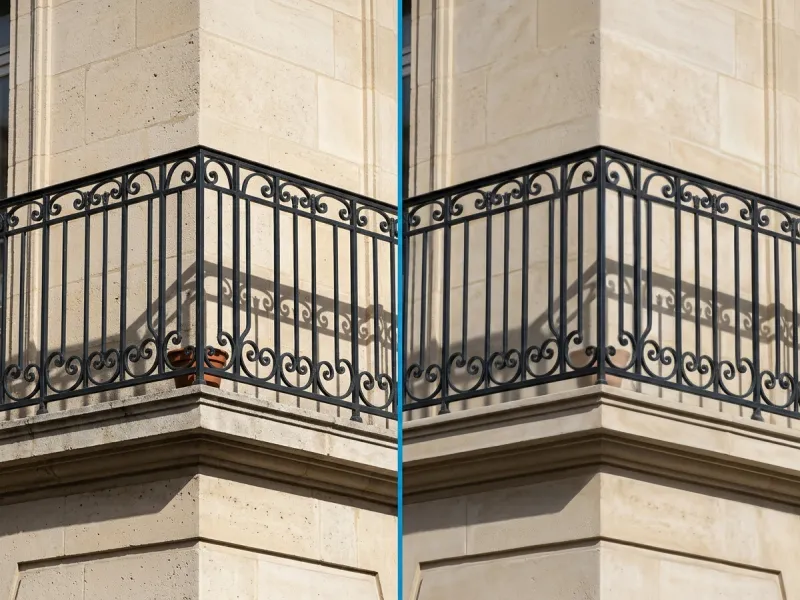
Uniform mortar joints and directional shadow edges across adjacent planes.
Abruptly smoothed compression grain and residual halo along edited ironwork.
Quick summary
- Free allowance
- 1 successful check, no sign-up required
- Supported files
- JPEG, PNG, WebP, GIF (first frame), and HEIC (auto-converted & resized in browser to 5 MB / 20 MP)
- Retention
- Private report expires in 24 hours (deletable sooner)
- Scope & method
- AI vs. human probability + visual cues — read how it works
Photo manipulation detector: what it can and cannot find
AI-edited photos and generative fill. Modern tools can replace a sky, swap a face, or insert objects seamlessly into a real photograph. This edited image detector combines an AI-generation classifier with visual forensic inspection of edges, lighting, and texture, built on the same pipeline as the main AI image detector.
Why localized edits are harder than full AI images. When 90% of an edited photo is real camera sensor data, a global AI score may lean human-made even if one region was altered.
Traditional Photoshop cloning and splicing. Copy-pasted regions, altered receipt numbers, and cut-and-paste composites do not necessarily trigger an AI generator signature. Always compare against original documents or earlier copies.
No C2PA or guaranteed tamper proof. Imagefake does not verify cryptographic C2PA provenance chains and cannot guarantee detection of every subtle retouch or edited detail.
| Category | How it was made | What Imagefake signals | Recommended next step |
|---|---|---|---|
| Fully AI-generated | Entire scene synthesized by a generative model | AI / human classification with model confidence | Inspect anatomy, text, shadows and trace source |
| AI-edited | Real photo with localized inpainting or face swap | May miss small edits when most pixels are photographic | Compare earlier versions via reverse image search |
| Traditional manipulation | Cloning, splicing, altered numbers or false caption | Not certified by an AI classifier | Verify directly with the publisher or issuer |
Visual clues of photo manipulation
Edge transitions and haloing. Look closely around hairlines, shoulders, and inserted objects where blur or sharpness abruptly changes compared to adjacent surfaces.
Shadow direction and color temperature. Check whether cast shadows and specular highlights on a subject agree with the rest of the scene.
Repeating texture and warped straight lines. Inspect brick walls, tiles, window frames, and text near edited areas for cloned patches or subtle warping.
Inconsistent noise or compression grain. Inserted patches sometimes look noticeably smoother or sharper than the surrounding photograph.
How Imagefake structures the inspection
Step 1: Metadata stripping & validation. Supported JPEG, PNG, WebP, and GIF files up to 5 MB / 20 MP are validated and cleaned of selected EXIF/XMP headers.
Step 2: Global AI-generation signal. Our upstream classifier evaluates overall AI vs. human probability.
Step 3: Region-level visual forensic summary. Visual inspection highlights notable areas across lighting, edges, anatomy, and typography. Unlock full findings plus 5 permanent checks for $0.99 one-time with Apple Pay, Google Pay, or card.
When to verify outside an automated detector
Financial documents, invoices, and receipts. Verify amounts, dates, and reference numbers directly with the issuing bank, merchant, or platform.
Insurance claims and damage photos. Request multiple angles, uncropped originals, and independent inspection.
Portraits and identity checks. Still-image detectors cannot verify identity or detect video/blink cues.
Frequently asked questions
How can I tell if an image has been edited?
Upload the picture for 1 free check to review global AI signals and visual forensic cues across lighting, edges, and surface texture, then inspect the original camera file and run a reverse image search for earlier unedited copies.
Can an edited image detector catch small Photoshop edits?
It can flag AI-inpainted regions and highlight suspicious seams, lighting mismatches, or texture smoothing, but small traditional Photoshop retouches, clone-stamping, or changed text inside a real photo can still pass undetected.
Can a photo manipulation detector catch Photoshop or localized edits?
It can flag AI-generated regions and surface visual inconsistencies in lighting, edges, and texture, but no automated classifier catches every traditional clone, splice, or small retouch. Always check original sources.
Does Imagefake generate a pixel manipulation heatmap or ELA map?
No. Imagefake provides an automated AI/human classification alongside a structured visual forensic breakdown of specific regions and cues, rather than a pixel-level ELA map or cryptographic C2PA verification.
How much does a manipulation check cost?
1 free check. No account needed. Unlock a full visual forensic breakdown + 5 permanent checks for $0.99 one-time (no sign-up, Apple Pay / Google Pay / card), or subscribe for $2.99 per calendar month (20 checks). Active subscribers can also buy 10 permanent credits for $1.49. Checks are subject to available capacity.
Can I check edited receipts, screenshots, or marketplace photos?
You can upload JPEG, PNG, WebP, or GIF (first frame) files up to 5 MB. Do not upload sensitive personal documents or confidential records, and verify document claims with the issuer.
Are uploaded photos stored permanently?
Imagefake keeps its image copy and report for up to 24 hours, and you can delete a completed report sooner. Our detection provider may retain anonymized images to improve its models; its retention is separate. Do not upload sensitive or confidential images. Read our privacy policy for details.
Can I use the report as legal or forensic proof?
No. Reports document automated model signals at a point in time and are not certified forensic opinions or legal proof. See terms.